Clients choose a tile and then choose a pattern, usually in that order and usually from a photograph. It is worth knowing what each pattern does to the number before you fall in love with one, because the range from the cheapest layout to the most expensive is wider than the range between two tiles.
The baseline is a straight stack
A stack bond, where every joint lines up in both directions, is the fastest layout to set and our baseline of 1.0. It is also the least forgiving. Continuous joints in both directions mean any bow in the wall or variation in tile size reads along a three metre line, so the wall has to be flat to within about an eighth of an inch over ten feet and the tile has to come from a single caliber.
The 15 inch rule
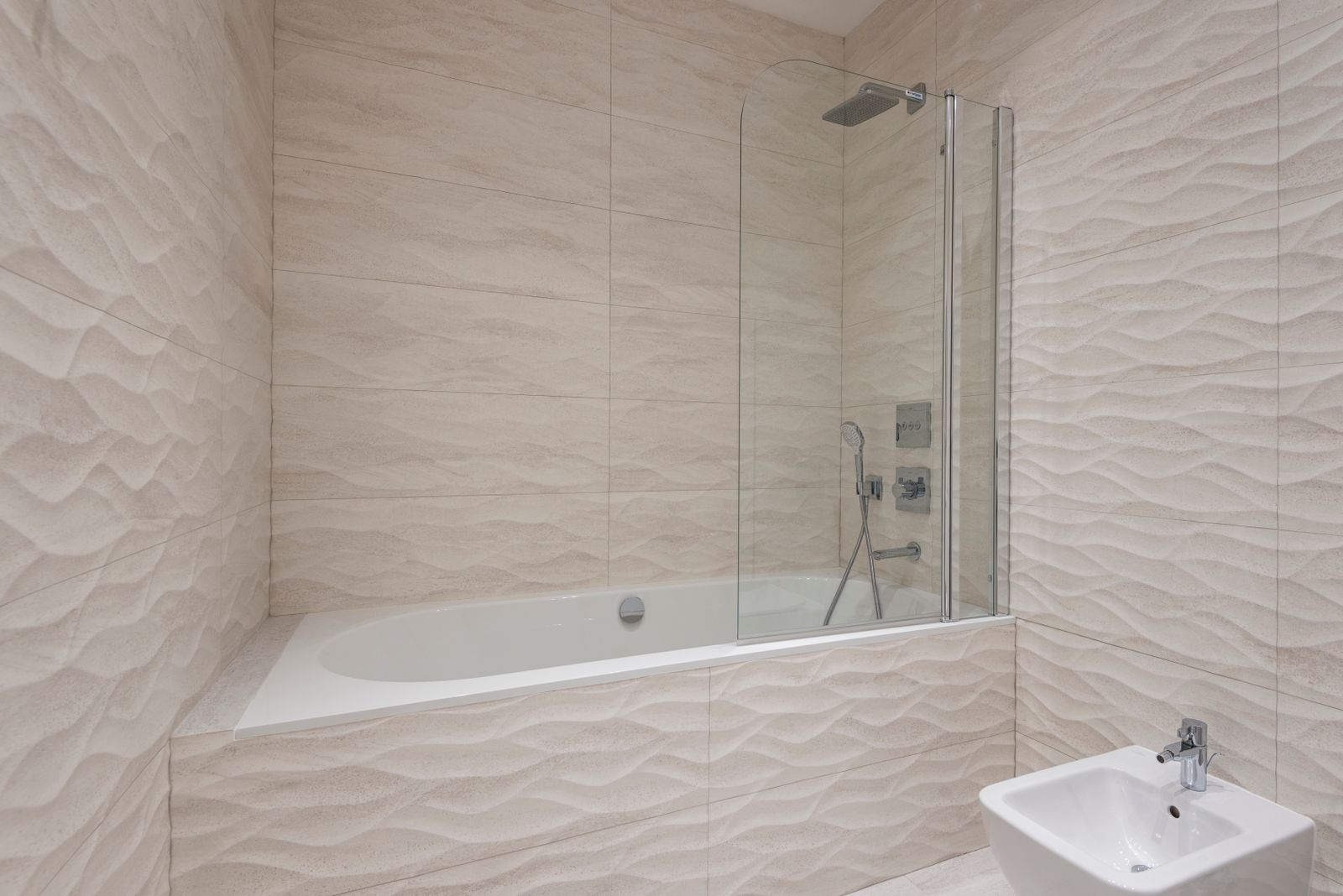
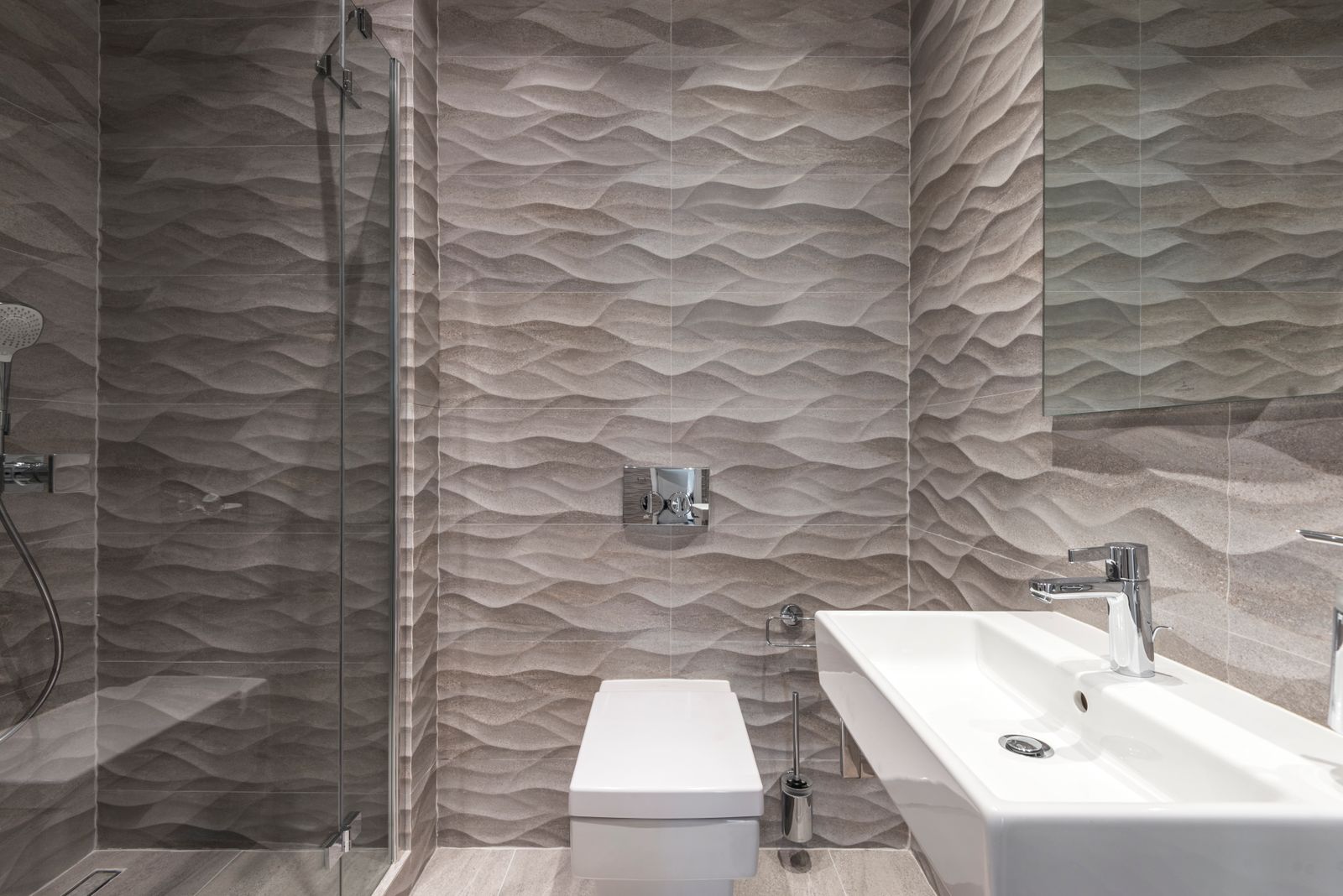
This is the one worth remembering. If any side of the tile is longer than 15 inches, the offset between rows should not exceed 33 percent. Plank tiles are made by pressing, and pressing leaves a slight crown in the middle of the tile. Put the corner of one tile against the crown of the tile below it, which is exactly what a 50 percent offset does, and you get lippage you can feel with a bare foot.
A third offset steps the joint away from the crown. It is why almost every large-format shower wall we set runs at a third rather than a half, and why the half-offset plank tile is the single most common defect we are asked to look at in other people's work.
What each pattern costs
Labour multipliers against a stack bond, with typical waste factors:
- Stack bond: 1.0x labour, 8 to 10% waste
- Running bond, half offset: 1.1x, 10%
- Third offset: 1.15x, 10 to 12%
- Vertical stack: 1.2x, 10%
- Versailles module: 1.3x, 10%
- Basketweave: 1.4x, 12%
- Chevron: 1.45x, 12 to 15%
- Herringbone at 90 degrees: 1.5x, 15%
- Herringbone at 45 degrees: 1.7x, 18%
Herringbone only works with true 2:1 tile
A herringbone needs the tile length to be exactly twice its width. Not nominally: actually. A tile sold as 3 by 6 that measures 2 and 15/16 by 5 and 7/8 will not close, and the error accumulates so that by the third course the pattern has visibly drifted. Measure the tile in the box, not the number on the box.
Chevron is different again and people confuse the two constantly. Chevron tiles are mitred at the ends so they meet in an unbroken V; herringbone tiles are plain rectangles that interlock in an L. You buy chevron as a purpose-cut tile. Cutting it on site from rectangles almost never closes cleanly.
And penny round on a shower floor
Small-format mosaic on a shower floor is not a style decision, or not only one. The grout area gives a wet dynamic coefficient of friction well above the 0.42 threshold, and the small format conforms to a floor falling in four planes to a centre drain without every piece needing to be back-buttered and adjusted.
The cost is grout: four to five times the volume of a large field tile. Specify something stain resistant, because there is a great deal of it and it is the part of the floor that will show first.